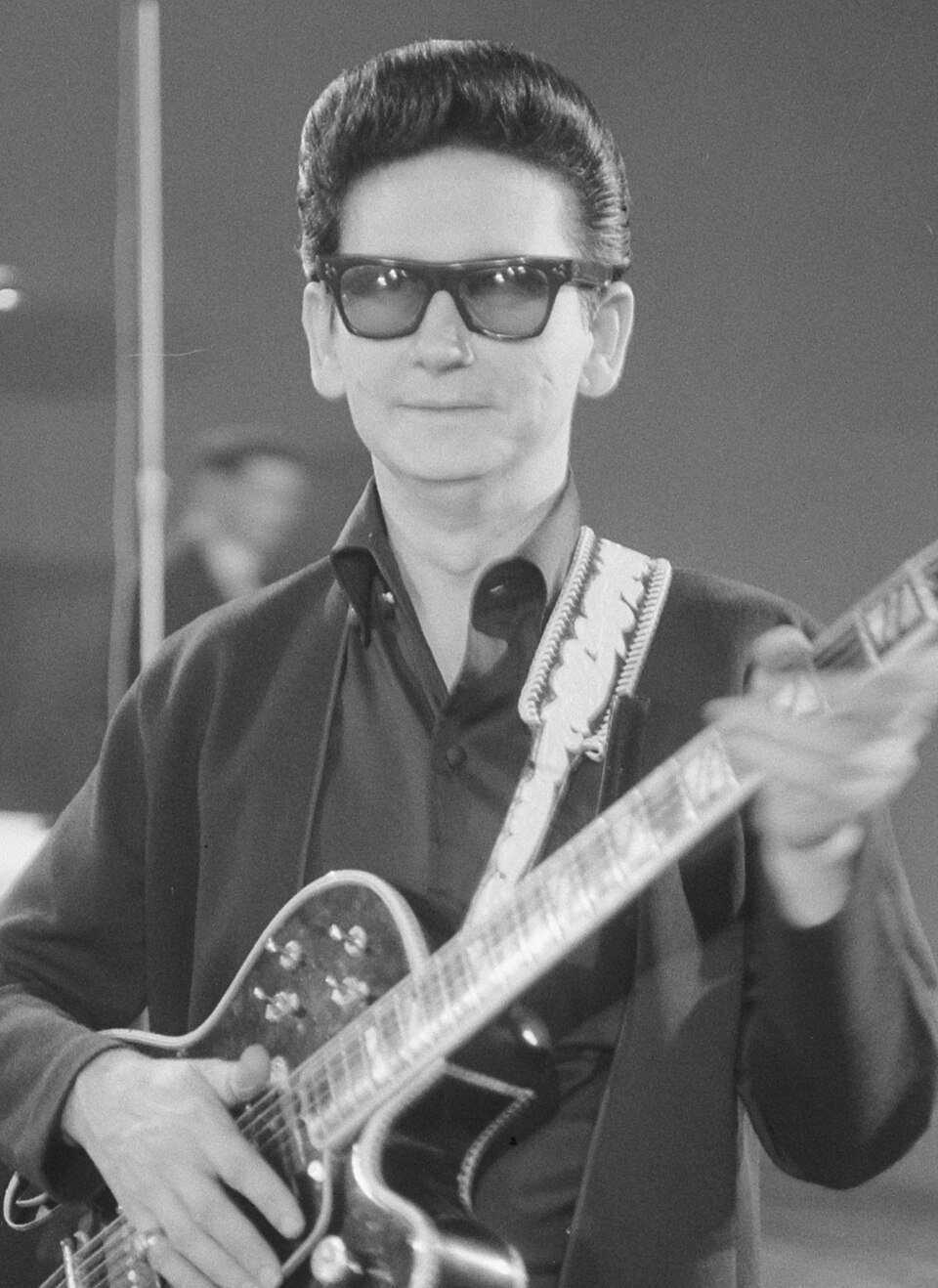
He stood perfectly still, dressed in black, wearing dark glasses, and then he sang. The first notes of Roy Orbison’s voice seemed to come from somewhere far beyond the stage, a place of longing so pure that audiences fell silent in wonder. In an era of shaking hips and screaming teenagers, Roy did something almost revolutionary: he stood still and let the song do the moving. His voice climbed, note by note, into a range that seemed almost impossible, and it carried with it stories of love, loss, and hope that have never lost their power. This is the untold story of a shy Texas boy who became one of the greatest singers of all time.
A Texas Childhood Shaped by Music and Hard Work
Roy Kelton Orbison was born in Vernon, Texas, in 1936, and grew up in Wink, a small oil town where life was plain, hard, and full of music. His father gave him a guitar when he was six, and Roy learned to play and sing with a seriousness that surprised everyone. He listened to country music, to gospel, to the blues, and to the early stirrings of rock and roll, absorbing each style without ever losing his own voice. As a teenager he formed bands, played local dances, and dreamed of a career that seemed impossibly far away. Yet even then, his singing had a quality that made people stop and listen: it sounded older, wiser, and more emotional than his years.
The Sun Records Years and the Search for a Sound
In the 1950s, Roy found his way to Sun Records in Memphis, the legendary label that had launched Elvis Presley, Johnny Cash, and Jerry Lee Lewis. Roy recorded rockabilly songs, including Ooby Dooby, which gave him his first taste of chart success. Yet Sun never quite knew what to do with a singer whose greatest strength was not swagger but vulnerability. Roy’s voice was too operatic for simple rockabilly, too emotional for straightforward country. He left Sun still searching for the sound that would let him be himself. That search would lead him to Nashville, to new songwriting partners, and to a series of records that changed popular music forever.
Only the Lonely and the Birth of the Orbison Sound
The breakthrough came in 1960 with Only the Lonely, a song Roy wrote with Joe Melson. It was unlike anything else on the radio: a ballad that built slowly, with a string arrangement, a dramatic vocal, and a climax that seemed to soar into another world. The record was a huge hit, and it established the Orbison sound: songs that began quietly, almost conversationally, and then rose, step by step, to an emotional peak. Roy’s voice, with its extraordinary range and its almost classical control, became the centre of that sound. Listeners who had never heard anything like it were captivated, and Roy, the quiet man in black, became a star.
Crying, Running Scared and a String of Unforgettable Hits
What followed was one of the great runs in pop history. Running Scared, Crying, Dream Baby, In Dreams, Blue Bayou, and It’s Over followed in quick succession, each one a small drama of the heart. Roy sang about men who loved deeply and lost painfully, about dreams that faded at dawn, about loneliness that felt almost physical. His songs were not simple; they were operas in miniature, with verses that set a scene, choruses that ached, and endings that lingered long after the record stopped. Other singers admired him, songwriters envied him, and audiences trusted him to sing about feelings they themselves found hard to express.
The Dark Glasses and the Man Behind the Image
Roy’s famous look, black clothes and dark glasses, began almost by accident. He had left his regular glasses on a plane and wore sunglasses on stage, and the image stuck. It became part of his legend, giving him a mysterious, almost otherworldly presence. Behind that image, however, was a gentle, funny, and deeply shy man. Friends described Roy as kind, modest, and endlessly curious about music. He did not seek the spotlight for its own sake; he sought it because singing was the way he expressed himself best. The stillness on stage was not aloofness. It was concentration, a singer giving everything to a song and asking the audience to do the same.
Oh, Pretty Woman and a Song for the Ages
In 1964, Roy recorded Oh, Pretty Woman, a song that would become his signature hit and one of the most famous records ever made. With its unforgettable guitar riff, its playful lyric, and Roy’s soaring vocal, the song was an instant classic, reaching number one on both sides of the Atlantic. It showed a lighter, more playful side of Roy, a man who could sing about attraction and fun as convincingly as he sang about heartbreak. The song has never left popular culture. It has been covered, sampled, and used in films, and every time it plays, listeners still smile at that opening riff and wait for Roy’s voice to take flight.
Tragedy, Resilience and a Voice That Refused to Break
Roy’s life was marked by terrible tragedies, including the loss of his first wife in a motorcycle accident and the loss of two of his sons in a house fire. It is hard to listen to his later recordings without hearing the weight of those experiences. Yet Roy continued to sing, to tour, and to write, finding in music a way to endure what life had given him. His voice never became bitter; it remained tender, even when singing about loss. That resilience is part of why his music moves people so deeply. Roy did not sing about sorrow from a distance. He sang about it as someone who knew it intimately, and who still believed in love.
The Traveling Wilburys and a Late-Career Triumph
In the late 1980s, Roy enjoyed a remarkable comeback. He joined George Harrison, Bob Dylan, Tom Petty, and Jeff Lynne in the Traveling Wilburys, a supergroup that brought him to a new generation. He also recorded Mystery Girl, an album that showed his voice undimmed and his artistry as strong as ever. Younger musicians spoke of him with awe, as a singer’s singer, a man whose records they had studied note by note. Roy seemed genuinely delighted by this late recognition. He had never stopped believing in his music, and now the world was reminding him, loudly and lovingly, how much it mattered.
A Legacy Sung in a Whisper and a Roar
Roy Orbison died in December 1988, just as his comeback was reaching its peak. The sadness of that timing only deepened the affection felt for him. In the years since, his influence has grown, not faded. Singers from every genre cite him as an inspiration, and his records continue to be discovered by listeners who are astonished that one voice could contain so much feeling. Roy’s legacy is not about fashion or image; it is about the rare ability to make a song feel like a confession, a prayer, and a promise all at once. That is a gift few singers possess, and Roy possessed it completely.
Listening Again to the Man in Black
Put on a Roy Orbison record tonight, close your eyes, and listen to how he builds a song. Notice the quiet beginning, the careful climb, the moment when his voice seems to leave the ground altogether. Notice, too, how human it all feels, even at its most dramatic. Roy Orbison was not just a great singer; he was a great storyteller, a man who turned his own heartbreaks and hopes into music that belongs to everyone. That is the untold story, and also the simplest one: a shy boy from Texas who stood still, dressed in black, and sang his way into eternity.
Leave a Reply